

Showing posts with label harp. Show all posts
Showing posts with label harp. Show all posts


My friend Guilherme came visiting from Amsterdam and we took the opportunity to go to a Son of Dave concert at the Botanique, a cultural centre in downtown Brussels. The activities that they have there are impressive!
The show was very good and we had great fun, what SOD does as a one man band is indeed amazing. But it was also a concert without surprises, as I had seen several performances of his on youtube and elsewhere. Google for him, it is certainly worth it.
[I've googled for you:
videos, loads of them!]
For those who don't know him, SOD is a former member of the Crash Test Dummies and performs using simple percussion, his voice, harmonica and a loop box. And that's it. Really cool.
More pictures on Picasa, as usual:
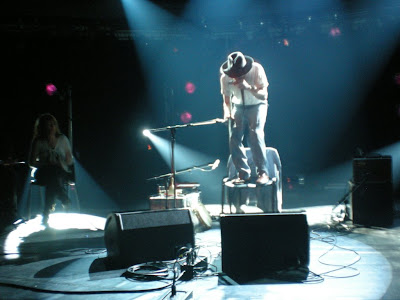 |
| From 081018 Son of Dave at the Botanique |
For those who don't know him, SOD is a former member of the Crash Test Dummies and performs using simple percussion, his voice, harmonica and a loop box. And that's it. Really cool.
More pictures on Picasa, as usual:
 |
| 081018 Son of Dave at the Botanique |
I am eating something similar to a Soupy Snax, so I decided to publish this text I wrote as an MBA assignment. It is one case were I can combine the themes MBA and harmonica safely.
I had previously seen the Soupy Snax 4:00 example somewhere, but it is a very good instance where the purpose of the product is so well communicated to the client.
In yet another example of the harmonica industry, Hohner has secured for them the best name a diatonic harmonica could ever have: "The Blues Harp".
Harmonicas are divided in mainly 3 groups: traditional instruments, chromatic instruments and, the most popular, the ten hole diatonic harmonicas. The latter are the more affordable models and are the only ones whose notes can be soulfully bent, giving it the characteristic wailing sound so intrinsic to harmonica blues playing.
But these instruments are not known as ten hole diatonic harmonicas, but under the nick name "blues harp". So, by registering this name decades ago, Hohner has made sure that, when an aspiring musician comes to a music dealer and asks for a harmonica to play the blues, he or she will probably ask using the most common name in English (and several other languages, additionally): "I want to buy a blues harp". The consumer is not aware that he is using a specific model name, but he has narrowed the choice of the dealer to this Hohner product. If he or she asks for a blues harp and gets a Hohner Blues Harp, he or she will be reassured to be buying the correct item. If the dealer offers a Suzuki Folk Master, which is a very similar instrument, the customer might become confused.
Just as a side note, the most traditional blues harmonica is The Hohner Marine Band, which, for a harmonica, is an awful name, as it doesn't convey any meaningful message to today's population (the Marine Band was a popular American Navy brass band in the late 19th century).
Hohner has tried to name their chromatic harmonica in a meaningful way. A chromatic harmonica is a harmonica which, differently from the other two categories* of instruments, can play a full chromatic scale. It was probably the most significant invention in 200 years of harmonica history. The name the Germans out of Trossingen came up with was "The Chromonica", which should convey the differentiating quality of this instrument. They had success in that, as it is easy for a buyer to figure out that he or she is doing the correct purchase when looking for a chromatic instrument. But Hohner's hopes of establishing the name Chromonica as a synonym for chromatic harmonicas didn't really work out that well. Some older generation Germans will use it in that way, but most of the harmonica community uses the term "chromatic harmonica" instead.
During my stay there, we launched the "7 Blues Harmonica Starter Set", which is a set with 7 inexpensive and low quality harmonicas, for a very affordable price. We tried to manage consumers' expectations by including the "starter" word in the name and by mentioning in the package that this was the ideal product for starters wanting to experiment with different keys or tonalities. Furthermore, we refrained to use the expression "blues harp" to differentiate this product from the actual "blues harp" model.
*Okay, not really. Richter style harmonicas and even tremolo harmonicas can be played chromatically with the use of advanced techniques.
And see this concert:
Pat Bergeson
26 Jun 2008, 20:00
Montreal Jazz Festival
With Annie sellick and the Hot Club of nashville featuring Richard smith, Aron Till and Charlie Chadwick and Pat bergeson Opening for Leonard cohen
I just found out about Pat through the Seydel newsletter. Besides being an extraordinary harmonica player, he is also a great guitar player, guitar being his main instrument. And he is opening for Leonard Cohen, which also should be quite interesting.
But I went to Canada during the wrong season for music festivals, definetely.
After having met so many great people because of my involvement in on line harmonica communities, this shouldn't surprise me anymore. But it does, every time: the power of belonging to an international network of like minded people is astounding!
I am at the moment in the Silver Dollar bar, on Spadina next to the University. On stage is Jerome Godboo from the Brokenjoe band, a harmonica player I had heard on the Internet because somebody recommended him on Harp-L, the (mostly) American harmonica on line discussion group. On that same discussion, Manfred, a Toronto based harmonica enthusiast, encouraged me to call him up once I arrived.
I did, and Manfred was kind enough to give me great tour around downtown Toronto yesterday, and we ended up talking shop in his house for a couple of hours.
He then called Mark "the bird" Stafford up and arranged for us to meet today (the 31st of Dec) and again I spent a great afternoon discussing and learning about the harmonica.
Mark made then sure that I came to hear Jerome, to whom I introduced myself passing regards from Mark.
And so it goes almost everywhere I go. I let the folks from Harp-L know that I will be in town and somebody gets in touch. I have already written that I saw Miguel Weissman in NY and met both PT Gazell and Jelly Roll Johnson in Nashville.
In Germany I have visited players in Munich, Stuttgart, Frankfurt, Hannover, Duesseldorf, Hamburg, Muenster, Berlin, Klingenthal and Trossingen (of course!), to name a few places.
In England I met Brendan Power almost by chance in London and got to know and meet again a bunch of very friendly people in Bristol, at the National Harmonica League's convention. In Brazil some of my best friends are harmonica players and, during the years I have got to know or at least meet many of my harmonica role models, also in Moscow, France or Hong Kong.
And if I don't forget that my last and coolest job I owe to these connections and the Internet (thanks Steve Baker!), then I shouldn't be surprised by all this anymore.
Now I just have to find out how to apply all this in a business setting.
Obs.: Jerome played a good set, the bar is cool, but the ticket was really expensive: CA$ 40,00! But I figured out that it is New Year and didn't want to spend the evening in the hostel, even though it really is a damn cool hostel!
 If I talk about going to a harmonica convention and having lots of fun there, I imagine that many people might think this is at least a bit curious.
To give a better impression of what I heard there, I am posting the following link to a sound clip.


